Every January we get the same email: the camera died and the panel is covered in snow. Sometimes the panel is covered in snow. Most of the time it is not, and the real story is in what the camera logged in the three days before it went dark.
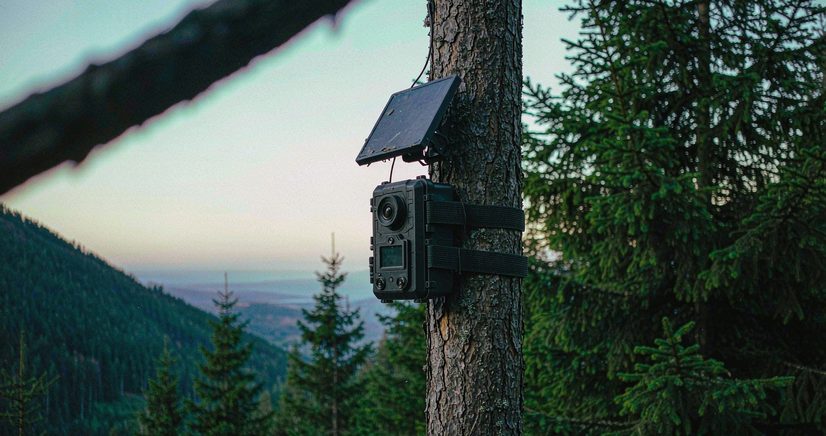
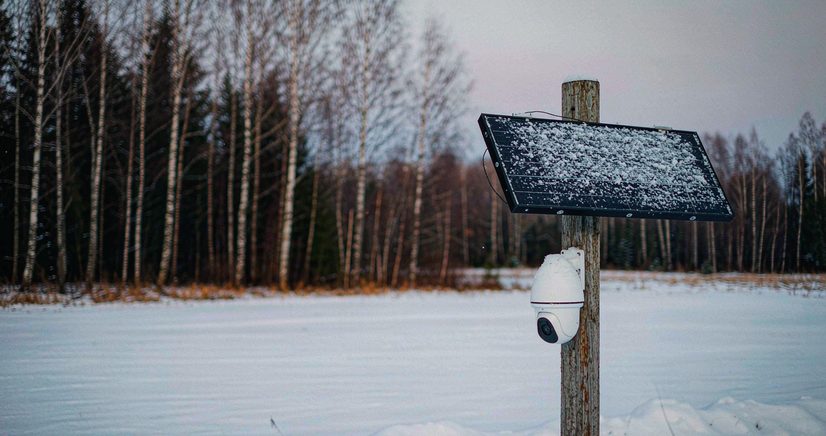
This is the log from a Ring Stick Up Cam on a fence line north of Duluth, running one of our 10W panels with the integrated 10,400 mAh battery. It is the longest cold-weather run we have a full record for, and it changed how we describe the mount.
The setup
- Ring Stick Up Cam (battery model), set to the default motion sensitivity.
- 10W panel, mounted on a fence post at 38° from horizontal, panel bottom about 40 cm above the average snow line.
- Camera under the eave of a pole barn, so the lens never saw direct snow.
- Wi-Fi access point 22 m away, through one exterior wall.
The panel was not chosen for the camera’s daily draw — it was chosen for December, when the sun in northern Minnesota is up for eight and a half hours and rarely at full strength.
What −20 °C does to a battery
Cold does not destroy a lithium cell. It raises its internal resistance, which means two things happen at once: the camera draws more current for the same job, and the cell accepts charge more slowly. A panel that keeps up comfortably in October can lose the race in January without anything being broken.
The camera’s own reporting made this visible. Between −5 °C and −20 °C the daily percentage drop overnight was roughly linear. Below −20 °C it steepened — the same footage, the same motion count, more energy spent getting it.
Nothing failed. The margin simply shrank, night after night, until a cloudy week ate it.
The four things that mattered
1. Height above the snow line. Not the panel’s height, the bottom edge’s height above where snow actually settles. Drifts are not uniform; the fence line drifted 30 cm higher than the driveway. A panel that is one good dump away from being buried is a panel that will be buried.
2. Angle. A steeper panel sheds snow instead of holding it, and in winter a low sun wants a steeper plane anyway. 38° was the compromise between shedding and the summer angle.
3. Cable routing. The first winter the cable was zip-tied along the post and the insulation cracked at the tie on the north face. It did not fail, but it was the one part of the install that aged. It now runs in a conduit clip with a drip loop.
4. Panel size, chosen in December. Sizing on a June day is how people end up with a 4W panel and a dead camera in February.
What the camera logged
Six weeks below −20 °C. The battery cycled between roughly 60% and 100% for the first four weeks, drifted down to 40% during a nine-day stretch of overcast, and recovered to 90% within three clear days. It never dropped below 30%, and it never stopped recording.
The number that surprised us was the event count: 40 to 70 motion events a day at the height of it, almost all of them snow sliding off the barn roof or a branch moving in wind. The camera was doing far more work than the “a few clips a day” figure people size for.
What we changed
Two things, both in the mount rather than the panel. The bracket now sets the panel at 35–45° with a hard stop, so it cannot be installed flat by accident. And the cable clip sits on the south face, where the sun keeps it dry.
If you are sizing for a cold climate, start one step up from the summer calculation and treat the snow line as a hard constraint, not a preference. The panels we ship for this job are on the solar panel range — the 10W in this log is the 10W with the integrated battery.